

Oh Merde!
How our poop could become our greatest asset

In The Earth, the 19th-century novelist, Emile Zola describes how an old woman in the village who has been reduced to a half acre grows huge and lush vegetables by fertilizing with human waste. Even in a novel where peasants are often standing waste deep in manure pile, the use of household excrement provoked disgust. The villagers jeer at her, calling her Mother Caca, which damaged her reputation but because her vegetables were so superior, the merchants and inn-keepers gradually got over their repulsion and Mother Caca made a good living on her small patch of land.
Meanwhile, Monsieur Hourdequin, the largest landowner in the village, suffered from financial problems. He bought fertilizers and the newest machinery, but could not compete with cheap American grain flooding the market and was steadily losing his fortune.
Watching Mother Caca, he became converted. Overcoming his disgust, he piped the slops of the kitchen, toliet and the farm into a resevoir and kept it damp with urine from humans and animals. His only regret was he didn’t have enough of the valuable stuff.
He turned an eye towards Paris where hundreds of thousands of people were relieving themselves in city toliets and privies. “The yearly refuse of Paris alone would be sufficient to fertilise some seventy thousand acres,” said the farmer. “It has all been properly calculated. And yet this is all wasted!”
In Amsterdam in the 21st century, the artist Fides Lapidairy converted a horse trailer so that it has two openings, one leading to a food truck, the other to a toilet. She sets it up at festivals. Visitors who used the composting toilet could walk around the trailer to the food truck counter and buy discounted sandwiches made with vegetables that Fides grew from earth fortified with the sandwich-eaters’ bodily donations. The sandwiches, grilled eggplant and zucchini, looked delicious. People eagerly lined up for the exchange.

Fides thanked people roundly for their fecal gifts to make the point that human feces is a collection of rich mineral resources sucked up from fields around the world, barged into Amsterdam, eaten, and ejected from human bodies. Instead of throwing this wealth away, she wants to mine it. Fides and her partner Yanna Hoek hold “Give a Shit” festivals each spring. They made a documentary film, “Holy Shit,” and regularly speak to groups of farmers, agricultural suppliers, policymakers and politicians. As crazy as it sounds, two long-legged young women peddling the values of poop are starting to have an impact. After their last “Give a Shit” festival, several parliamentarians raised the question of rethinking the country’s waste streams.
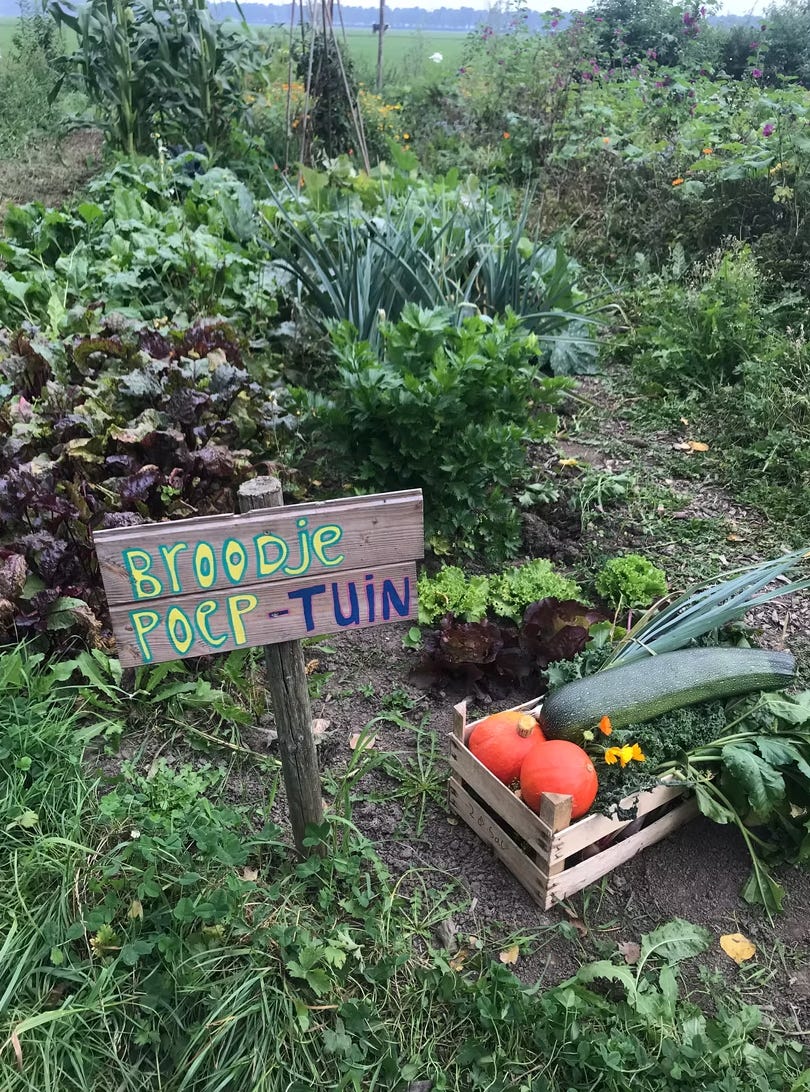
vegetables grown with the help of human feces.
Historians of the future will laugh at how humans for over a hundred years used flush toliets, one of those ideas that sounded good at the time. Of all sources of animal waste, human feces best feeds soils that grow food for humans. That is not surprising. Nutrients that nourish humans churn through bodies and come out the other end. In the Netherlands, precious agricultural minerals flushed down the toilet include 77 million pounds of phosphate and 74 million pounds of potassium a year. Agronomists worry that mining concerns will soon run out of phosphate in the coming decades. Fides is also concerned.
Fides hopes that by installing composting or vacuum toilets (like in airplanes) in new buildings, cities could conserve drinking water and help farmers overcome an addiction to artificial fertilizers made from petroleum products. Such commercial fertilizers supply plants with the basics they need to grow—nitrogen, phosphorous, potassium (NPK), plus some salt. If you taste fertilizer, it is very salty, like drinking seawater. Pumped up with salt, plants grow tall, and that makes farmers happy, but the produce contains a lot of water and is low in nutrition. Likely you have tasted large, but bland, watery tomatoes, peppers, strawberries, and celery. These fruits and vegetables do not inspire much culinary interest. Humans evolved to distinguish instinctively plants that are deep in color, fragrant, and rich in taste because they contain nutrients that best feed human bodies.
If people eat nourishing foods and compost them back into the ground, the same nutrients are now in the earth, feeding soil organisms that in turn cycle them back to plants that produce the roots, seeds and fruits which sustain human health. Fides’ point is simple. Close the loop and suddenly every human is a producer of soil and plant food, and our worlds become so much richer. If you have read this far, you probably already know that soils with deep humus that are rich in fungal and microbial life store both water and carbon with astonishing efficiency. All you have to do, Fides is saying, is give a shit.
That is correct, Lee. If night soil is not composted (and this is the same with raw cow, pig and chicken manure which is dumped by the tons onto farm fields), there is a danger of bad bacteria getting onto your food. Compost piles heat to over 160 degrees and that kills the pathogens.
Very instructive, as always!